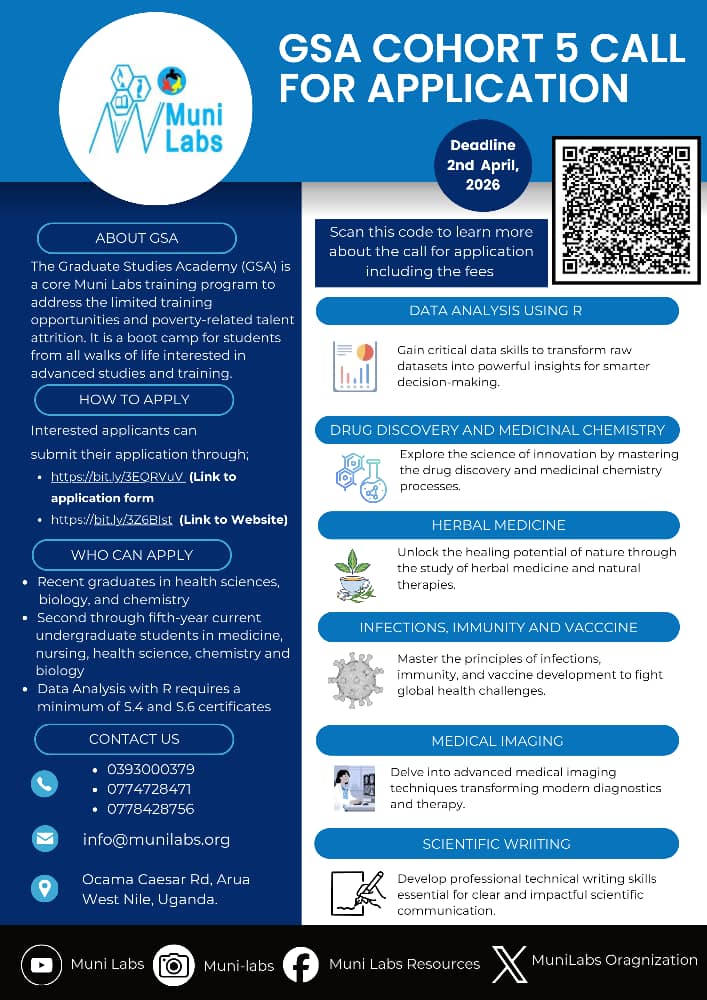
CALL FOR APPLICATION TO GRADUATE STUDIES ACADEMY (GSA)
MUNI Labs is a local NGO established in 2017 to mobilize support for rural health capacity in partnership with Muni University. Muni Labs is happy to announce the Graduate Studies Academy (GSA), a preparatory training program for advanced studies. The GSA is uniquely tailored to each student to maximize their chances of success in their desired careers in Uganda, Africa, and globally. It is a preparatory service but not a formal academic program.
The GSA is structured as follows
Primer stage
A preparatory stage to awaken the curiosity in a student and prepare the student through basic modules for a career of interest. A student at this stage pays a modest fee to undertake the study.
SMART stage
Science and Medicine Applications and Research Training focuses the student in a specific career with an emphasis on laboratory-based projects to contribute in solving health-related problems. A student at this stage benefits from a monthly stipend during the period of study.
Placement stage
At this stage, the student is attached to a specific institution within Uganda, Africa, or globally in line with the career goal of the student to pursue further studies at masters or doctoral level.
Note that transitioning from one stage of the GSA study cycle to the next is competitive and not automatic.
Benefits of GSA
- Maximize chances of success in desired careers in Uganda, Africa, and abroad.
- For entrance in advanced programs like masters and PhDs.
- Opportunity to interact with mentors who lead in their areas of specialization.
- Skills and experience acquired are highly desired in job markets.
Documents to upload and submit
- S.6 certificate holders to attach copies of result slips and certificates.
- Current continuing undergraduate students in the second, third, fourth, and fifth years should attach their testimonials for the last academic year.
- Diploma and bachelor’s degree holders should attach their O- and A-level result slips and certificates, as well as their diploma and degree transcripts and certificates.
Fee structure
- Each course module costs Ugsh. 150,000= including certificate fee.
- You can apply for more than one course module.
Application Process
- Complete the online application form and upload the required documents
- The deadline for receiving applications is Saturday, 31st May 2025 at 5:00 pm. Short-listed applicants will be invited for interviews through email,
Primer Course Modules and eligibility criteria
S.6 certificate holders, diploma holders, and continuing undergraduate students, and bachelor’s degree holders in any field (evidence of computer knowledge applies to all applicants for this module).
Second, third, fourth, and fifth-year continuing undergraduate students of health sciences, and those with bachelor’s degrees in health sciences.
Second and third-year continuing undergraduate students doing bachelor of science or bachelor of science with education with chemistry/biology combination or majoring in chemistry or biology, and those with bachelor’s degree in BSc or BSc/Educ majoring in chemistry or biology.
Second and third year continuing undergraduate students undertaking Bachelor of Science or Bachelor of Science with education with chemistry/biology combination or majoring in chemistry or biology, and those with bachelor’s degree in BSc or BSc/Educ majoring in chemistry or biology.
Second, third, fourth, and fifth year continuing undergraduate students of health sciences, and those with bachelor’s degrees in health sciences.
Second- and third-year continuing undergraduate students undertaking a bachelor of science or bachelor of science with education in chemistry/biology combination or majoring in biology, and those with a bachelor’s degree in science or BSc/education majoring in biology or chemistry.
Second, third, fourth, and fifth year continuing undergraduate students of health sciences, and those with bachelor’s degrees in health sciences.
Any student or professional at any level of study.
Note: A diploma holder in health science-related courses can apply for any of the course modules 2, 3, 4, 5, and 6.
All Courses run for a period of 3 months
Course Description
As the sole public university in West Nile, Muni University plays a vital role in Uganda’s Vision 2040, aiming to provide accessible and high-quality healthcare for all residents. This certificate course aims to familiarise students with medical imaging. More advanced students will acquire knowledge and skills in obstetric ultrasound to offer antenatal imaging services to low-resource health facilities in the West Nile region.
In the two-part course, students will learn the basic theory and practice of medical imaging technologies, procedures, and data interpretation for disease diagnosis and localisation. Additional skills, such as patient preparation, positioning for imaging exams, equipment adjustment for high image quality, administering radiation to some patients, ensuring patient safety and comfort during imaging, patient education, precise execution of imaging requests from physicians, management and reporting of imaging data records, documenting medical data in the patient’s EMR (electronic medical records), and coordinating patient schedules will also be covered.
The course is designed to provide the student basic information about herbal medicine and drug development. It will introduce students to the history and development of herbal medicine throughout the years. Traditional methods versus modern methods of herbal medicine preparation will also be covered. The course will focus on the classification and basic nomenclature and taxonomy of plants and crude drugs, their modes of action, monographs, quality control, methods for extraction, characterization, detection of active ingredient in medicinal plants and secondary metabolites. Quality control along the herbal medicine value chain from cultivation or wild crafting of plants through to their manufacture. The course will also introduce the learners to the concepts of testing herbal products from pre-clinical to clinical trials and the processes involved. The course will cover topics on bioprospecting the process of drug discovery and drug development. The students will also be introduced to the concepts of safety and efficacy of herbal medicines and an introduction into herbal medicine research landscape.
Course Description
About this short course: Medical advances have been the bedrock of human development because of their impact on mortality and morbidity, and effective medicines are the principal instruments of medicine. For that reason, the study of how medicines or drugs are discovered, developed, and manufactured is critical for society to continue tackling current and future health challenges. However, the topic of drugs has largely been reserved for an esoteric group, and in the past, secretive groups of people. The inherent safety risks associated with administering drug substances to human beings make the field of drug discovery highly rigorous and intimidating.
This short course is intended as a primer to demystify drug discovery and medicinal chemistry. It will introduce students to what it takes to make medicines, including key tenets, conceptual frameworks, and processes, as well as opportunities in the pharmaceutical industry. The course is only a primer to introduce students to general concepts and is not intended to be a professional training course or program.
Some of the topics covered in this short course will include the history of medicines, factors that drive disease and target selection, drug candidate discovery, drug action, metabolism, pharmacokinetics and clinical trials. The module also includes special topics on drug discovery technologies and approaches to enable students to delve deeper into certain topics and perhaps spur a deeper interest in them.
The GSA’s “Introduction to Data Analysis with R” course has been meticulously designed to provide participants with a strong foundation in data analysis using the powerful R programming language. This course is tailored for beginners with little to no prior experience in data analysis or programming.
Throughout this course, participants will acquire essential data analysis techniques, explore data visualization, and gain hands-on experience in data manipulation and analysis using R. By the end of the course, participants will possess the knowledge and skills necessary to perform fundamental data analysis tasks, create insightful visualizations, and make informed decisions based on data-driven insights.
"Developing Health Care Capacity in rural Uganda"
P.O box 1024
Arua, Uganda
info@munilabs.org
+256(0)393-000-379
+256(0)776-493-183
+256(0)777-355-025